
Sprint Retrospective
Last updated on 2026-10-14 | Edit this page
Estimated time: 10 minutes
Overview
Questions
- How do we conduct Sprint Retrospective meetings?
- What does this meeting achieve for the team and the Scrum
process?
- How can previous retrospective actions and Sprint Velocity inform future sprints?
Objectives
- Demonstrate how positive and negative retrospective feedback can be used to improve the Scrum process.
- Learn how to review previous action items and create actionable
plans for continuous improvement.
- Please do not read the notes line by line or display all of the text during the course, as this may overwhelm participants. Prepare thoroughly in advance and explain in your own language or use the diagrams where present to explain concepts visually and guide discussion.
- Keep each challenge time boxed; remember too that the timings stated are only a guide. It is likely that the learners will take longer in this chapter in the first sprint, but less time in subsequent sprints as they become accustomed to the course material.
7.1. Introduction
In this episode, you will learn how to prepare for and conduct a Sprint Retrospective Meeting, in order to improve the processes in future Sprints.
7.2. Sprint Retrospective Meeting
Sprint retrospectives are regular meetings that take place at the end of every sprint.
Their purpose is to help the team reflect, learn, and continuously improve.
A retrospective aims to:
- Evaluate how the previous sprint iteration or work item went — focusing on team dynamics, processes, tools, and their Definition of Done (DoD).
- Identify, articulate, and prioritise what went well and what didn’t.
- Create and implement a plan for improving the way the team works.
Important: Every team member should attend the retrospective, with a member of the team leading the discussion. This member can be the scrum master, product owner, or it can rotate throughout the team.
Benefits of sprint retrospectives
Achieve continuous improvement: Building an action plan and following up on it in future meetings is critical for growth.
Improve team reflexivity: Reflexivity is the extent to which team members collectively reflect upon the team’s objectives, strategies, and processes and adapt them to current or anticipated circumstances.
Tips for Scrum Masters
Encourage the team to regularly review their capacity at the end of each sprint. Understanding how much work was realistically completed helps teams set achievable goals and forecast future progress.
Introduce Sprint Velocity as a supportive metric. Sprint Velocity reflects the amount of work the team completed during the sprint and can help guide future sprint planning — not as a performance measure, but as a signal for improvement and predictability.
-
When planning upcoming sprints, the team should consider the average velocity from previous sprints along with other factors such as holidays, technical challenges, or external dependencies.
For example: If the team’s average velocity is 15 story points and there are no expected blockers, the team may commit to user stories totaling around 15 points for the next sprint.
In the sprint retrospective meeting, use velocity trends to identify what supported or slowed the team’s progress. This can highlight systemic issues, process improvements, or opportunities for better collaboration.
Ensure that participants practise calculating their sprint velocity in at least one sprint. Then encourage the team to think about velocity when creating the retro improvement list (during the retro meeting in Challenge 2).
After the first sprint:
During the retrospective, the team can calculate sprint velocity by summing the story points of all completed user stories. The total represents the sprint velocity for that sprint.For subsequent sprints:
Sprint velocity should be calculated as the average of all previous sprint velocities.
Ensure the following, as the team calculates velocity
- The team should create a list of all user stories that are fully completed.
- These must be stories that have met all acceptance criteria and have been approved by both the Scrum Master and Product Owner.
- Exclude partially completed stories: If a user story is only 90% complete, it should not be considered finished. Move it to the next sprint and re-evaluate the story points based on the remaining work.
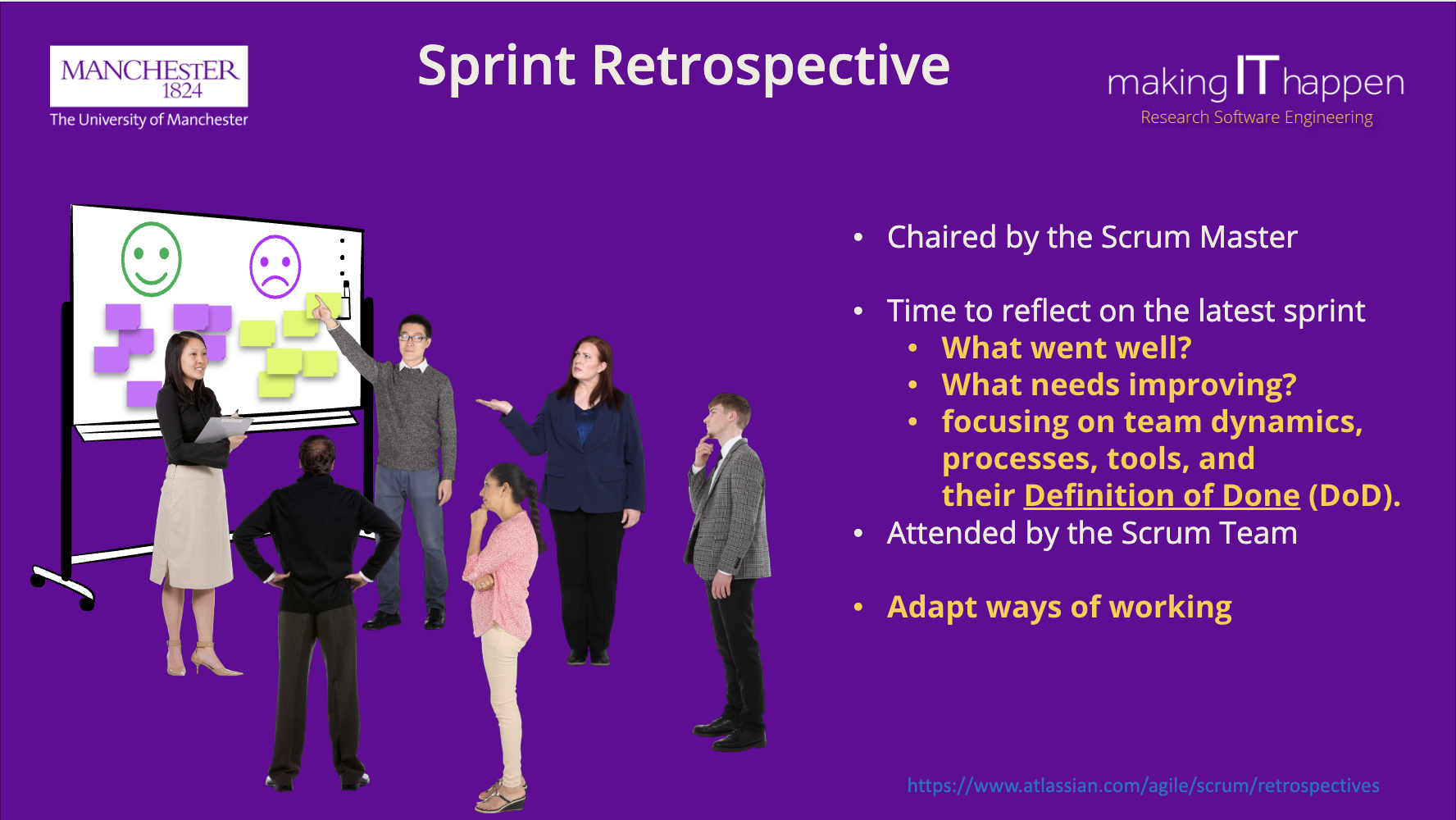 Image Source: Agile Methods for
RSE
Image Source: Agile Methods for
RSE
Challenge 1: Review Previous Retrospective Actions (2 minutes)
IMPORTANT: Skip this challnege if you are in the first sprint.
Before jumping into the retrospective meeting for the latest sprint, the Scrum Master should lead a short review of the action items agreed during the previous sprint retrospective.
Step 1. Display the previous retrospective’s action list (from the “What changes can we make?” column).
Step 2. Review each action item briefly, confirming:
- Whether it has been completed
- Whether it is still in progress
- Whether it requires further discussion or new actions
Step 3. Celebrate completed actions and acknowledge improvements achieved.
Step 4. Highlight any actions that were not completed and discuss whether they should:
- Be carried forward
- Be re-defined
- Be dropped if no longer relevant
Step 5. Carry any outstanding items into the new retrospective only if the team agrees they remain valuable.
Challenge 2: Conduct a Sprint Retrospective (6 minutes)
Scrum Master: Facilitate the Session
Step 1. Set Up the Retrospective Wall
Prepare a Retrospective Wall, clearly labelled with the sprint name and three columns:
- What went well?
- What went wrong?
- What changes can we make? (Actions)
Tip: Don’t forget to reflect on your Definition of Done (DoD). Did our DoD help us deliver a usable increment? If you learned something new, you can update the DoD during this Challenge.
Note: Online participants: use the Sprint Retrospective Area on the Miro board. In-person teams: use the physical board/wall provided.
Step 2. Gather Input from Team Members
- Ask each team member to write their thoughts on Post-it notes (in
person) or into an element on the retro board (online) in response to
the first 2 questions above.
- They should place each note under the appropriate column.
Step 3. Cluster Similar Ideas
- As a team, group similar notes together to create clear themes. (This helps focus the conversation and reduces duplication)
Step 4. Vote on Key Issues (Under “What went wrong?”)
- All participants vote on the notes in the “What went wrong?” column that they believe represent the biggest risks, blockers, or issues affecting team progress.
Step 5. Discuss the Top Issues
Identify the top two items with the most votes and discuss each one, focusing on:
- Why it happened
- How it affected the sprint
- What the team can do differently next time
Note: Keep the discussion solution-focused and time-boxed.
Step 6. Select Key Actions and Create an Action Plan
- Agree on clear and achievable action items that address the top
issues.
- Add these to the “What changes can we make?” column and assign an owner for each.
Note: If no owner is assigned, the Scrum Master will take responsibility for ensuring the action is followed up.
Further Guidance for Scrum Masters
- Ensure every team member participates and has the opportunity to
contribute.
- Prevent any individual from dominating the conversation — all voices
should be heard equally.
- Manage time carefully for each activity and steer the discussion
back on track if it begins to drift.
- Encourage a psychologically safe environment where honest reflection is welcomed.
Review of Action Items
- The Scrum Master will review the actions at the next Sprint Planning meeting to keep all action items visible during that session and to ensure they are addressed.
- These actions should also be reviewed at the start of the next
retrospective meeting to confirm what has been completed and what still
needs attention.
- The Scrum Master is responsible for ensuring that priority items are progressed and ideally completed by the time the next retrospective is held.
- Sprint Retrospectives provide a structured opportunity for the team
to reflect, learn, and improve processes.
- Reviewing past action items ensures continuity, accountability, and
progress before planning the next sprint.
- Sprint Velocity is a supportive metric for planning achievable
workloads and identifying trends in team performance.
- Effective retrospectives rely on facilitation, collaboration, prioritisation, and psychological safety to encourage honest reflection.