
Instructor Notes
This is a placeholder file. Please add content here.
Learning Objectives
Outline and Agenda
Getting a Scrum Project Started
INSTRUCTOR NOTE: BEFORE YOU BEGIN
This chapter is intentionally detailed to support your preparation.
Please do not read it line by line or display all of it during the course, as this may overwhelm participants. Instead, familiarise yourself with the user story map (USM) and supporting details in advance, and focus on presenting the main diagrams during the session. Use the diagrams to explain concepts visually and guide discussion.
Keep Challenges time boxed but allow for discussion of concepts as appropriate.
Instructor Note
Note for the Facilitator acting PO: Refer to the provided PO Guide to decide whether Challenge 2 is needed, based on the number of personas specified for the product scenario.
Sprint Planning
INSTRUCTOR NOTE: BEFORE YOU BEGIN
- Please do not read the notes line by line or display all of the text during the course, as this may overwhelm participants. Prepare thoroughly in advance and use the diagrams to explain concepts visually and guide discussion.
- Keep each challenge time boxed; remember too that the timings stated are only a guide. It is likely that the learners will take longer in this chapter in the first sprint, but less time in subsequent sprints as they become accustomed to the course material.
Instrutors Guide: Section Planning Across Sprints
The entire DoD section 4.3.0., along with the associated Challenge 2, only needs to be addressed in Sprint 1. For the rest of the Sprints it would be covered in Sprint Retrospective Chapter.
Instructor Note
What are some best practices for creating a definition of done?
- Define the criteria with your team: Defining the DoD should be a collaborative effort that involves the whole team, including developers, testers, product owners, and relevant stakeholders. Creating a DoD ensures a shared understanding of what it means for a product increment to be complete.
- Keep it visible: The DoD should be available and visible during sprint planning or when there are discussions around estimating product backlog items. The team should be able to refer to it regularly. Print it out and hang it on the wall, or include it in a wiki or the project plan.
- Be practical and realistic: The DoD should be achievable within the time frame and with available resources. More importantly, it should be relevant to what customers actually need.
Instructor Note
When Consensus Cannot Be Reached
If it is likely that a consensus is not going to be reached after a few rounds, then the User Story can be shelved as the uncertainty around it is just too high for it to be planned at that time. It is likely that a secondary task will need to be generated on the product backlog to explore options that may bring greater clarity to the estimate.
Sprint Development Work
INSTRUCTOR NOTE: BEFORE YOU BEGIN
- Keep each challenge time boxed; remember too that the timings stated are only a guide. It is likely that the learners will take longer in this chapter in the first sprint, but less time in subsequent sprints as they become accustomed to the course material.
INSTRUCTOR NOTE: Just for your knowledge, not to be shared with participnats
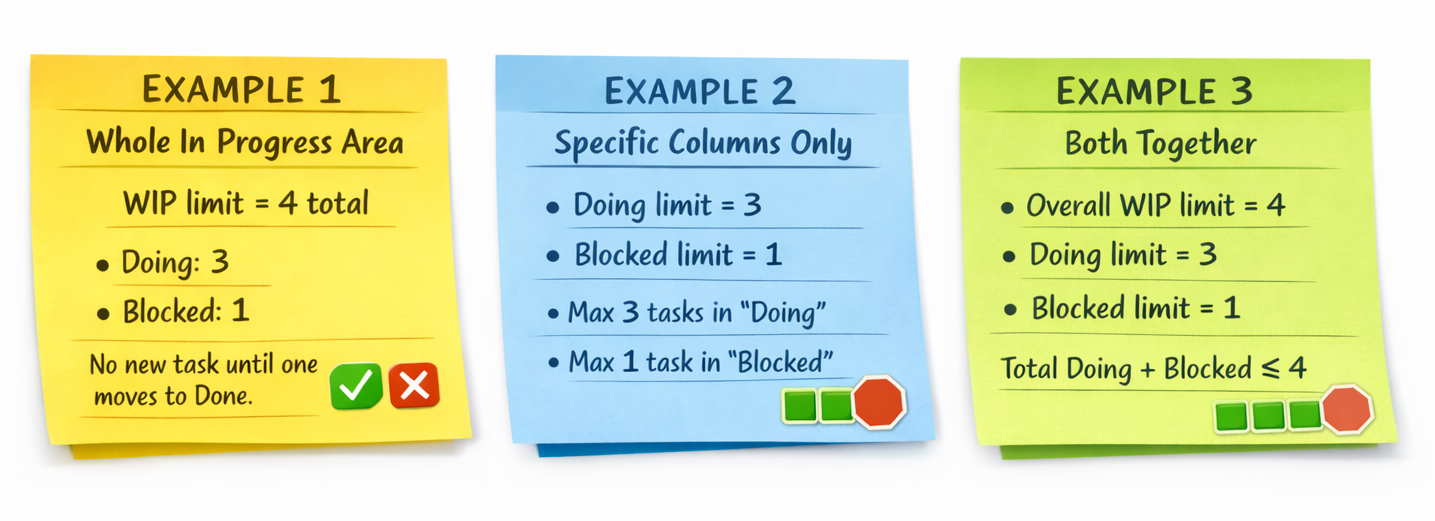
WIP limits can be applied to individuals, teams, or even the entire organisation. They can be set for the whole “In Progress” area of a Kanban board, for specific columns, or for both.
Sprint Review
INSTRUCTOR NOTE: BEFORE YOU BEGIN
Please do not read the notes line by line or display all of the text during the course, as this may overwhelm participants. Prepare thoroughly in advance and explain in your own language or use the diagrams where present to explain concepts visually and guide discussion.
Keep each challenge time boxed; remember too that the timings stated are only a guide. It is likely that the learners will take longer in this chapter in the first sprint, but less time in subsequent sprints as they become accustomed to the course material.
Sprint Retrospective
INSTRUCTOR NOTE: BEFORE YOU BEGIN
- Please do not read the notes line by line or display all of the text during the course, as this may overwhelm participants. Prepare thoroughly in advance and explain in your own language or use the diagrams where present to explain concepts visually and guide discussion.
- Keep each challenge time boxed; remember too that the timings stated are only a guide. It is likely that the learners will take longer in this chapter in the first sprint, but less time in subsequent sprints as they become accustomed to the course material.
Instructor Notes: Practising Sprint Velocity Calculation
Ensure that participants practise calculating their sprint velocity in at least one sprint. Then encourage the team to think about velocity when creating the retro improvement list (during the retro meeting in Challenge 2).
After the first sprint:
During the retrospective, the team can calculate sprint velocity by summing the story points of all completed user stories. The total represents the sprint velocity for that sprint.For subsequent sprints:
Sprint velocity should be calculated as the average of all previous sprint velocities.
Ensure the following, as the team calculates velocity
- The team should create a list of all user stories that are fully completed.
- These must be stories that have met all acceptance criteria and have been approved by both the Scrum Master and Product Owner.
- Exclude partially completed stories: If a user story is only 90% complete, it should not be considered finished. Move it to the next sprint and re-evaluate the story points based on the remaining work.
Backlog Refinement
INSTRUCTOR NOTE: BEFORE YOU BEGIN
Please do not read the notes line by line or display all of the text during the course, as this may overwhelm participants. Prepare thoroughly in advance and explain in your own language or use the diagrams where present to explain concepts visually and guide discussion.
Keep each challenge time boxed; remember too that the timings stated are only a guide. It is likely that the learners will take longer in this chapter in the first sprint, but less time in subsequent sprints as they become accustomed to the course material.
INSTRUCTOR NOTE
Keep an eye on the MVP’s progress after each sprint
If the number of items is low and the team does not have enough work for the upcoming sprint, consider extending the scope by adding stories for another persona. Otherwise, this section given below can be skipped.