
Outline and Agenda
Last updated on 2026-10-14 | Edit this page
Estimated time: 5 minutes
Outline
- You are going to spend the day being part of a Scrum Team, working together on a micro-project.
- We will be adopting the various Scrum roles as defined in the reference section. In this course,
you will be working in Scrum Teams and will assume the following three
Scrum roles:
- Scrum Master: Each team will have one Scrum Master. Participants who express interest in this role will act as the Scrum Master. The expected responsibilities are here
- Product Owner (P.O): Each team will have one P.O. In some cases, participants who express interest in this role will act as the P.O. The P.O represents the Stakeholders, who are only “lightly engaged” with the process, and will help you clarify requirements as needed. The expected responsibilities of the P.O are here.
- Developer. The remaining participants in each team will act as Developers. The expected responsibilities are here.
- Where this course is different to a real project, is that we also have people acting a Facilitator. This is not a Scrum role but for the purposes of this course, Facilitators will ensure that their group is running to schedule, answer any course-related questions and will also assume the role of Product Owner when required.
Agenda Internal Course Run (UoM RSEs)
| Time | Item |
|---|---|
| PART 1: Agile Basics | |
| 9:30-10:00 | Introduction to Agile |
| PART 2: Practical Work | |
| 10:00-10:10 | Setup/Adjustment Time |
| 10:10-11:10 | Product Discovery |
| 11:10-11:20 | Coffee & Questions |
| 11:20-11:50 | Sprint 1: Planning |
| 11:50-12:05 | Sprint 1: Development Work |
| 12:05-12:25 | Sprint 1: Review |
| 12:25-13:15 | Lunch & Netwroking |
| 13:15-13:30 | Sprint 1: Retrospective |
| 13:30-14:40 | Sprint 2 (Backlog Refinement 10 mins, Planning 20 mins, Dev 15 mins, Review 15 mins, Retro 10 mins) |
| 14:40-14:50 | Coffee & Questions |
| 14:50-16:00 | Sprint 3 (Backlog Refinement 10 mins, Planning 20 mins, Dev 15 mins, Review 15 mins, Retro 10 mins) |
| 16:00-16:07 | Quick Break |
| 16:07-16:30 | Course Recap & Close |
Agenda External Course Run (outside UoM RSEs)
| Time | Item |
|---|---|
| PART 1: Agile Basics | |
| 9:30-10:15 | Introduction to Agile |
| PART 2: Practical Work | |
| 10:15-10:20 | Setup/Adjustment Time |
| 10:20-10:30 | Walk Teams through the Scrum Wall |
| 10:30-11:00 | Product Discovery Part 1 (before break) |
| 11:00-11:10 | Coffee & Questions |
| 11:10-11:50 | Product Discovery Part 2 (after break) |
| 11:50-12:30 | Sprint 1: Planning |
| 12:30-13:15 | Lunch & Netwroking |
| 13:15-13:30 | Sprint 1: Development Work |
| 13:30-13:50 | Sprint 1: Review |
| 13:50-14:05 | Sprint 1: Retrospective |
| 14:05-14:20 | Sprint 2 Backlog Refinement |
| 14:20-14:40 | Sprint 2: Planning |
| 14:40-14:50 | Coffee & Questions |
| 14:50-15:05 | Sprint 2: Development Work |
| 15:05-15:20 | Sprint 2: Review |
| 15:20-15:35 | Sprint 2: Retrospective |
| 15:35-15:40 | Quick Break |
| 15:40-16:00 | Course Recap |
| 16:00-16:30 | How the UoM RSE Department adapts and applies Agile + Any Questions |
Scrum Development Cycle Overview
As we explained in the slides in part 1 of this course, Scrum encourages the mindset where change is the norm and allows the (software) development process to embrace that change. The Scrum methodology fulfils this philosophy by using Sprint Cycles. Each Iteration (sprint) last 2-4 weeks, and gives the Stakeholders and Product Owner a chance to update priorities for the following sprint.
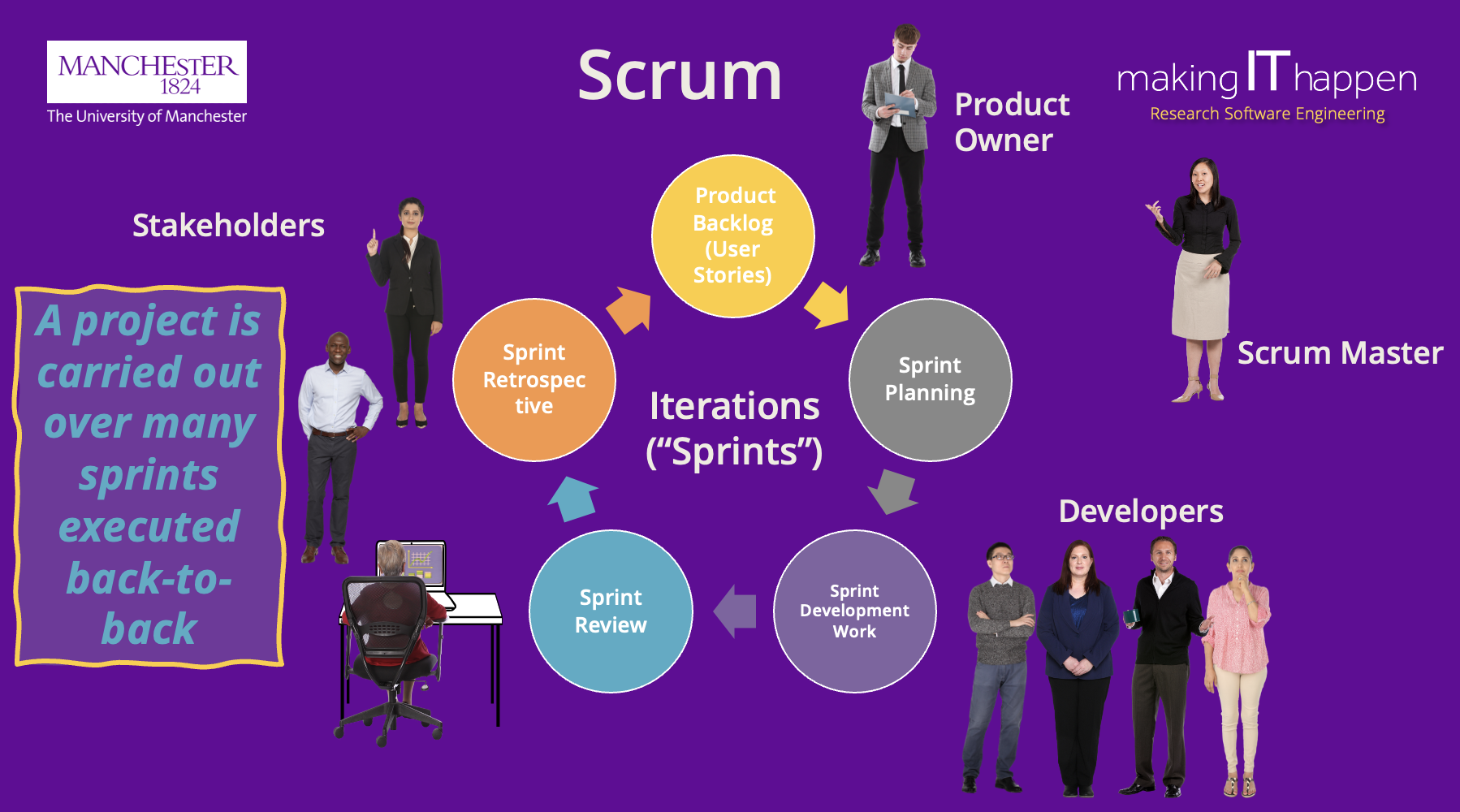 Image Source: Agile Methods for
RSEs
Image Source: Agile Methods for
RSEs
The following slide, shows the key Scrum Roles.
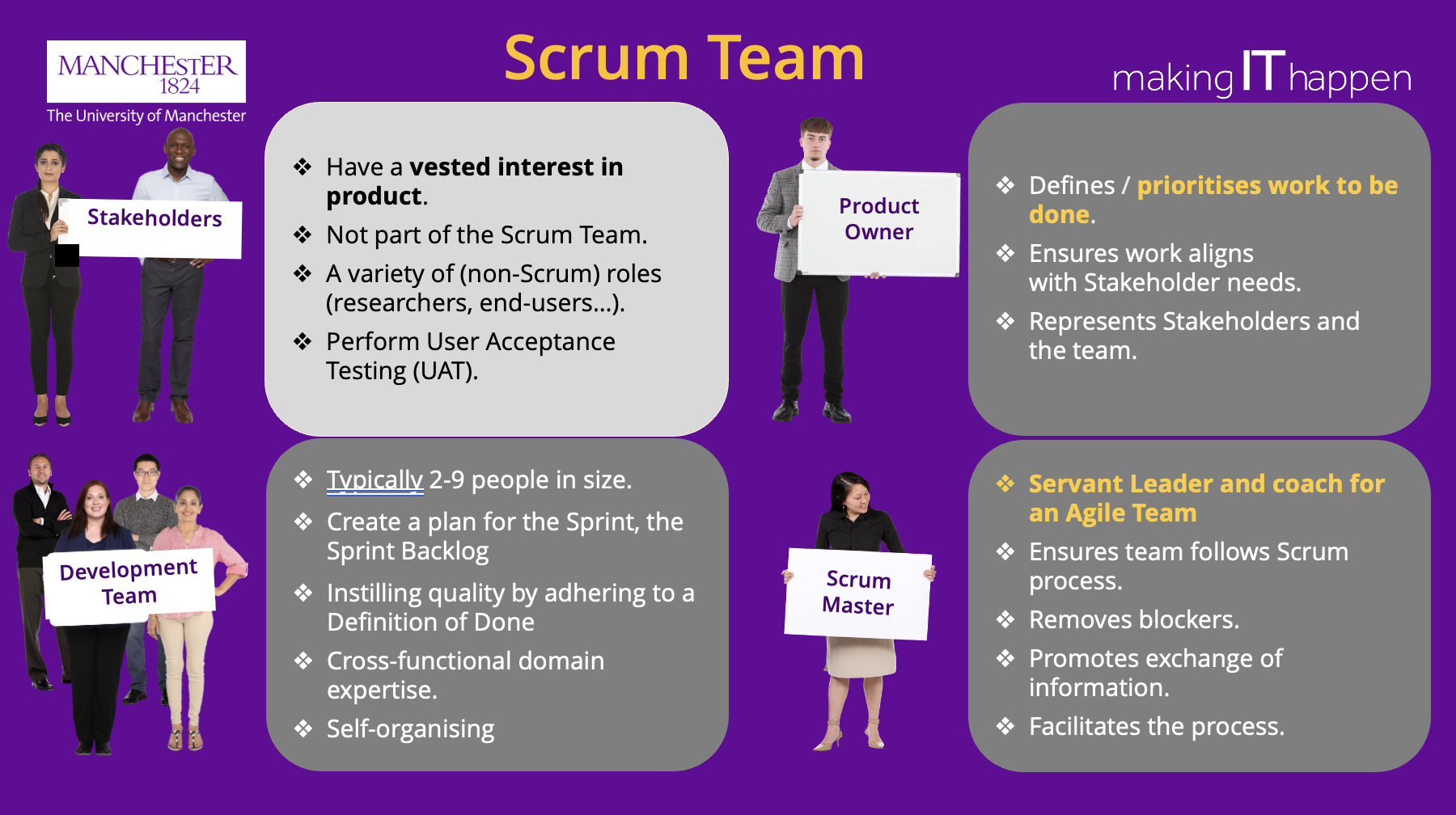 Image Source: Agile Methods for
RSEs
Image Source: Agile Methods for
RSEs
- You will be working on a Scrum Team of Developers for the day.
- All attendees will fulfil the Developer role at some point.
- Most attendees will also fulfil the Scrum Master role at some point.
- Some attendees will also fulfil the Product Owner role.
- The Facilitator is a role specific to the training course and can take on the Product Owner role if needed, in addition to keeping the Scrum Team on schedule.