
Sprint Review
Last updated on 2026-10-14 | Edit this page
Estimated time: 15 minutes
Overview
Questions
- How do we conduct Sprint Review meetings?
- What does this meeting achieve?
Objectives
- Use Sprint Review meetings to demonstrate the Sprint Increment to the Stakeholders.
- Evaluate the Sprint Goal progress and alignment with the Product Vision.
- Celebrate achievements and identify improvements.
Please do not read the notes line by line or display all of the text during the course, as this may overwhelm participants. Prepare thoroughly in advance and explain in your own language or use the diagrams where present to explain concepts visually and guide discussion.
Keep each challenge time boxed; remember too that the timings stated are only a guide. It is likely that the learners will take longer in this chapter in the first sprint, but less time in subsequent sprints as they become accustomed to the course material.
6.1. Introduction
In this episode, you will learn how to prepare for and conduct a Sprint Review Meeting.
6.2. Sprint Review Meeting
A sprint review meeting is a fundamental ceremony in Agile development, specifically within the Scrum framework. It marks the end of a sprint, during which the development team delivers a potentially shippable increment of product functionality.
In a sprint review, the Scrum Team and stakeholders gather to review and demonstrate the work completed during the sprint. This provides an opportunity to showcase the features developed, gather feedback, and ensure alignment with the product vision and requirements.
Important: Anyone can be the facilitator of the Sprint Review; they can be a member of the Scrum Team, one of the stakeholders, or someone not involved in the project at all. Often, the Product Owner (P.O.) facilitates the Sprint Review since they are the stakeholders’ representatives for the Scrum Team during the Sprint and they are often best at speaking the customer’s language.

6.3. Conduct a Sprint Review Meeting
Before conducting a sprint review meeting, you need to plan the review in advance. For example, decide which items will be reviewed and discussed.
Remember: only work that has met the “Definition of Done” can be included in the sprint review.
Challenge 1: Prepare for a Sprint Review Meeting (4 minutes)
In your teams,
-
Review the Sprint Backlog
- Look at all stories or features completed during the sprint.
- Identify which ones meet the “Definition of Done” and are ready for review.
-
Select Stories for the Review
- Choose stories to showcase in the meeting.
-
Plan the Demo Sequence
- Decide the order in which stories will be presented.
- Assign team members to demonstrate each story.
Now that you have planned your sprint review meeting, the next step is to understand the key activities involved. A typical sprint review includes:
- Demonstration of completed work
- Feedback collection
- Alignment with the product vision
- Celebration of achievements
- Identification of improvements
We will explore each of these steps in detail and guide you through practical exercises where necessary to experience the sprint review process firsthand.
6.3.1. Demonstration of Completed Work
The development team demonstrates the features completed during the sprint to key stakeholders, including the product owner, customers, and other relevant parties.
6.3.2. Feedback Collection
Stakeholders provide feedback on the demonstrated features, enabling the team to adjust and prioritise work effectively in subsequent sprints.
Challenge 2: Demo & Feedback Collection (5 minutes)
Note: Entire team, you are in the Sprint Review Meeting now!
Step 1: Demonstrate Completed Work
Present the increment built during the sprint.
-
For each story in the sprint backlog:
- State the sprint goal it
fulfils
- Demonstrate the designed features
- Refer to the existing acceptance criteria from the backlog to show how the story is done
- State the sprint goal it
fulfils
Step 2: Verify, Collect, and Process Feedback
-
Stakeholders (Product Owner in this training) check whether the work presented for each story meets the story’s acceptance criteria:
- All criteria met → success confirmed
- Some criteria not met → note bugs
- New ideas or enhancements
- All criteria met → success confirmed
The team records any bugs or enhancements on Post-its.
Enhancements are added directly to the Product Backlog (User Story Map).
-
Bugs are handled as follows:
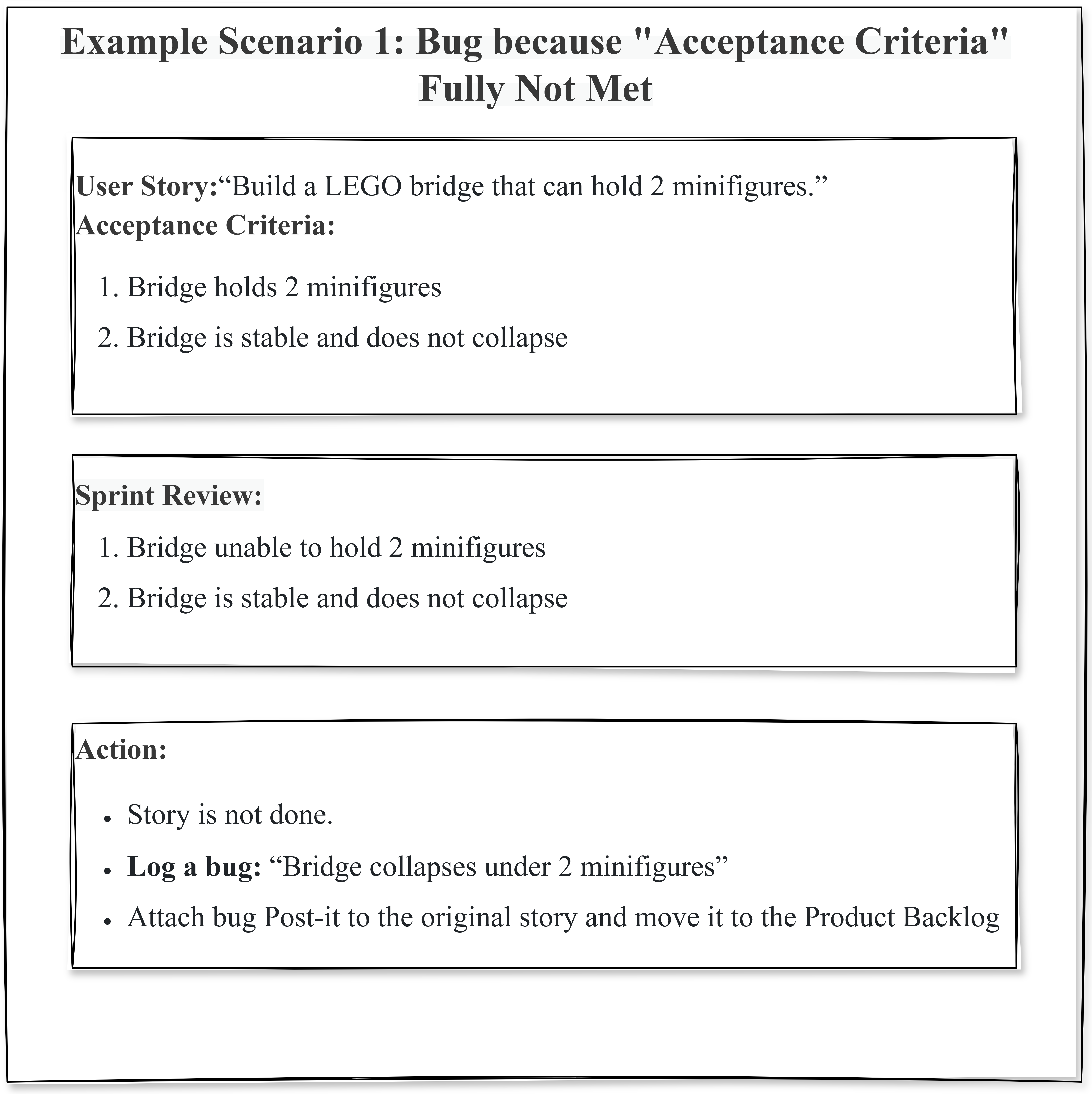
- If the bug arises because the story did not meet its acceptance
criteria, write it on the same Post-it if there is space, or use a new
Post-it attached to the original story, labeled as “bug” and move the
story back to the Product Backlog.
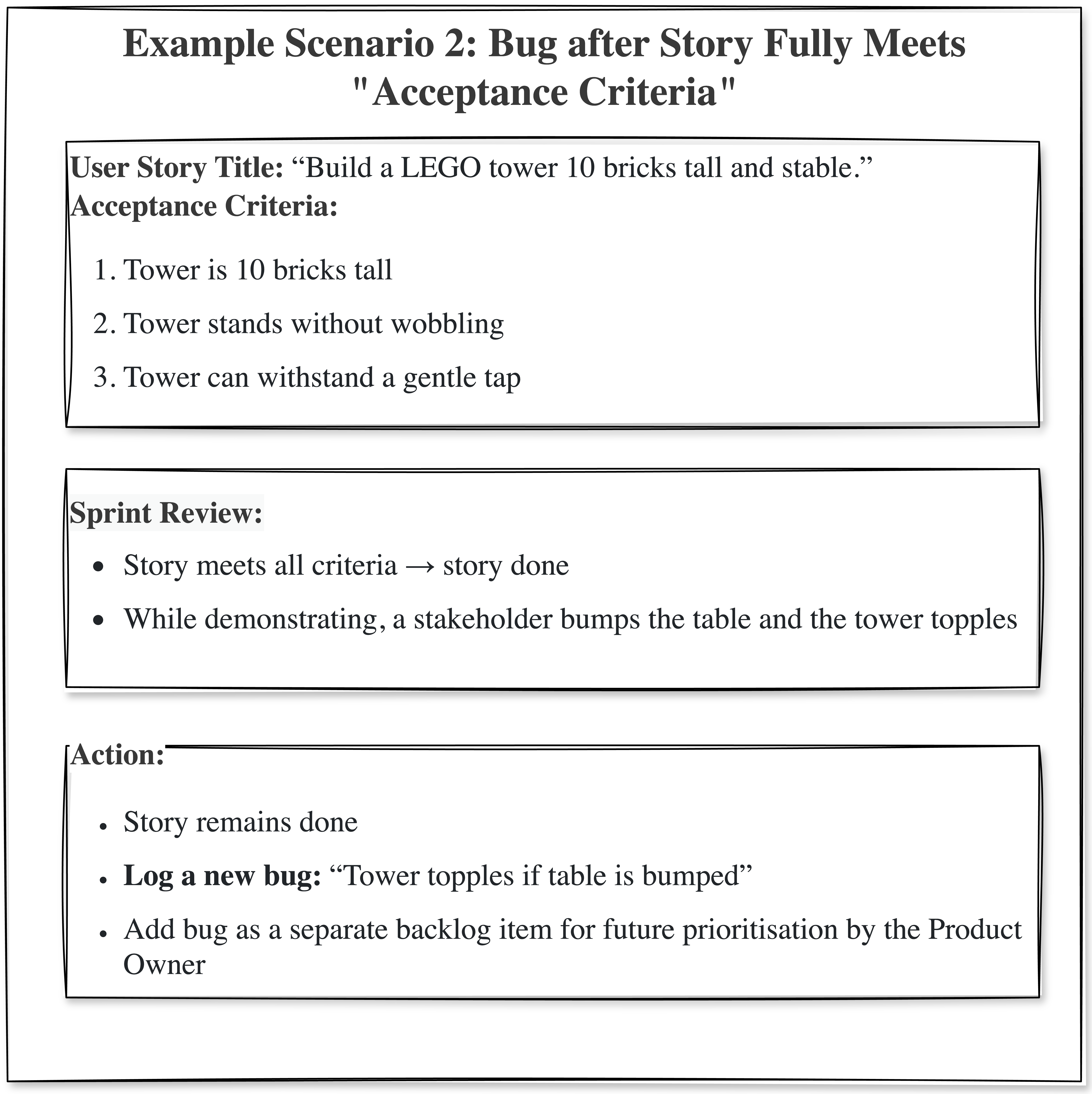
- If the story met its acceptance criteria, but a new bug is discovered, the story can still be marked as done. The bug should be added as a separate item in the Product Backlog for prioritisation during backlog refinement by the Product Owner.
- If the bug arises because the story did not meet its acceptance
criteria, write it on the same Post-it if there is space, or use a new
Post-it attached to the original story, labeled as “bug” and move the
story back to the Product Backlog.
See the example scenarios demonstrated in figures given below for both types of bugs.
Important: Do not prioritise or plan work on bugs or enhancements in the sprint review; this happens during backlog refinement.
6.3.3. Revisit the Sprint Goal and Check the Alignment of the Completed Work With the Product Vision
During the Sprint Review, the Scrum Team and stakeholders take a close look at how much progress was made toward the sprint goal. They also check whether the work completed fits with the overall product vision. This helps make sure the team is on the right track and that what’s being built is moving the product in the right direction.
Challenge 3: Evaluate the sprint goal progress and alignment with product vision. (3 minutes)
Instructions:
Review all completed stories in the sprint review.
-
Decide the overall sprint goal status:
- Fully achieved: All stories related to the sprint goal are complete and meet their acceptance criteria.
- Partially achieved: Some stories are complete, but one or more stories related to the sprint goal are incomplete or have unresolved bugs.
- Not achieved: Most or all stories for the sprint goal are incomplete or fail to meet acceptance criteria.
Check if the completed work supports the product vision.
Note down any gaps for discussion related to product or process.
Scrum Master: - Ensure product-related gaps are discussed in the Sprint Review meeting, as a part of this Challenge. Note that process-related gaps should be saved for the Sprint Retrospective meeting.
6.3.4. Celebration of Achievements
This provides an opportunity to celebrate the development team’s accomplishments and acknowledge their hard work and dedication.
CHALLENGE 4: Spotlight Moment (2 minutes)
Each team member, starting with the Scrum Master, should point out one thing another team member did that they found impressive, whether it’s a task, a contribution, or positive behaviour.
Rules:
- You only appreciate someone else
- Be specific. Here are some examples:
Task-based recognition
- “I appreciate how Alex designed the door hinge to reduce friction.”
Behavior-based recognition (listening, empathy, collaboration, support)
- “I appreciate how Adina checked in with teammates regularly to see if anyone needed support.”
- “I appreciate how Ann listened carefully to my concerns and asked thoughtful questions before suggesting a solution.”
- “I appreciate how David encouraged quieter team members to share their ideas in the meeting.”
- Avoid vague phrases like: “Good job, Alex.”
Scrum Master:
- Facilitates the appreciation round.
- Models the behavior by giving an example first.
- Ensures recognitions are specific and meaningful.
- Encourages visibility for silent or behind-the-scenes contributions.
- Helps the team practice consistent individual acknowledgment.
Missed a Recognition?
If this is your first sprint and you didn’t spot someone to recognise, don’t worry!
Pay attention during the upcoming sprint. Notice positive contributions, helpful behaviors, or tasks as they happen, so you can share your appreciation in the next Spotlight Moment 😊
6.3.5. Identification of Improvements
Through discussions and observations during the sprint review, areas for improvement in the development process can be identified and addressed in future iterations. These can then be shared in a future Sprint Retrospective.
In short, the sprint review promotes collaboration, transparency, and continuous improvement within the Agile development framework. It fosters a culture of open communication, collaborative working sessions, and shared responsibility for the product’s success.
- Sprint Review Meetings give the Scrum Team the chance to demonstrate the latest Product Increment.
- They are useful for checking the product is meeting the current requirements and to assist with refining the Backlog.